Kross Esker AL vs Romet Aspre AL: geometry and sizing compared
Torn between the Kross Esker AL and the Romet Aspre AL? See how position and handling differ, and which size of one matches the other. Numbers from the manufacturers' geometry charts, as of 13 Nov 2026.
Short answer
The Aspre AL is the sportier of the two, the Esker AL the more upright.
In size M/L, the Aspre AL has 6 mm less stack (580 mm vs 586 mm) and 19 mm more reach (406 mm vs 387 mm) than the Esker AL.
Riding a Esker AL M? The closest Aspre AL is size L.
1 minute, free, no account. Your height and flexibility, not a size chart.
Which version?
This page compares the Kross Esker AL (in M: 586 mm stack, 387 mm reach). Kross also sells versions with their own geometry:
Esker CF 7.0–8.0: in M 557 mm stack, 375 mm reach (−29 mm / −12 mm), so a clearly different geometry
Meet the two bikes
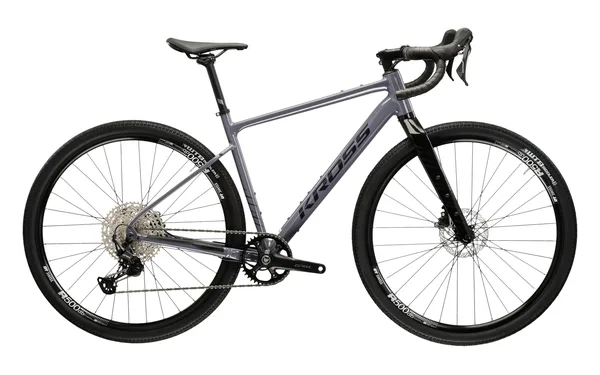
Pictured: Esker 5.0 GRX 1x12. Photo: KROSS
Kross Esker AL
Type
gravel
Tyres up to
50 mm
Launched
2024
Kross's aluminium gravel line, on sale since the 2019 season. The Gen 2 frame arrived for 2024 with a carbon fork, room for 50 mm tyres and plenty of mounts for bags and fenders. The 5.0 runs Shimano GRX 1x12 on 45 mm tyres; the 6.0 gets GRX 2x12.
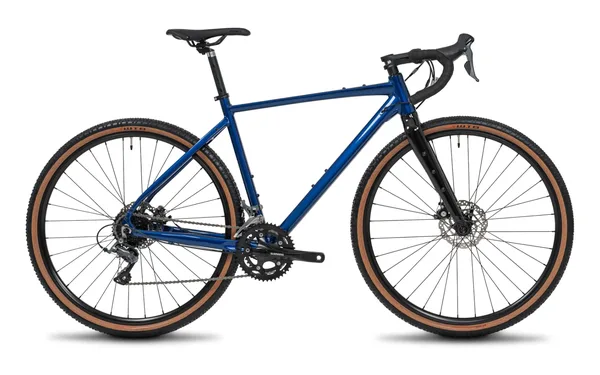
Romet's entry-level aluminium gravel, launched for the 2018 season below the Boreas. In July 2026 Romet showed the Aspre 1.0 with a new frame and geometry: an aluminium fork, Shimano Claris 2x8, mechanical disc brakes and 45 mm Schwalbe G-One Comp tyres, up from 38–40 mm before.
Frames only, drawn from the geometry: we don't have the stock stem lengths for both bikes, so the handlebar position is left out. Wheels and fork drawn with typical sizes.
Which one suits you?
Kross Esker AL
Closer to you if you want:
a more upright position for long, relaxed days
calmer at high speed
room for wider tyres (up to 50 mm)
Romet Aspre AL
Closer to you if you want:
a noticeably lower, sportier position
turns in more eagerly
Neither bike is better. Whether it fits depends on your body: height, inseam and flexibility. See your size in both →
What it means on the road
Position
The Aspre AL puts the bars slightly lower and noticeably further away than the Esker AL: you lean further forward, more of your weight goes onto your hands and your back gets flatter, so it feels noticeably sportier on fast gravel and tarmac. The Esker AL keeps you noticeably more upright and relaxed, which makes it easier to look far ahead and to stay comfortable through a long day. If you prefer the bars higher, spacers under the stem can bring back part of the height; how much depends on the cockpit and the steerer length.
Steering
The Aspre AL has the steeper head angle: it turns in more eagerly and feels livelier at low speed, while the Esker AL stays calmer when it gets fast and rough.
Stability
The Aspre AL has slightly longer chainstays, so the rear wheel sits further back: on steep, loose climbs the front stays down more easily and the bike feels more planted at speed, while tight switchbacks take a little more effort. The overall wheelbase barely changes, so the difference stays subtle.
Seat angle
The Esker AL has the steeper seat angle: you sit a little more over the pedals, which helps on seated climbs.
Your height isn't your bike size.
Check which size of each fits your body: 1 minute, free, no account.
Pick a size. The “Difference” column is Aspre AL minus Esker AL: green means more, amber means less.
Size:
Esker AL XS
Aspre AL S
Difference
Frame
Stackframe height at the head tube
558 mm
551 mm
−7 mm
Reachframe length to the head tube
365 mm
393 mm
+28 mm
HTAhead tube angle
70.5°
71.5°
+1°
STAseat tube angle (effective)
73.5°
74.7°
+1.2°
Head tubehead tube length
105 mm
125 mm
+20 mm
Chainstayrear end length
430 mm
435 mm
+5 mm
BB DropBB below the wheel axles
75 mm
—
—
Wheelbaseaxle to axle
1012 mm
1046 mm
+34 mm
Trailsteering stability
—
—
—
Stock stemas sold
60 mm
—
—
Esker AL S
Aspre AL S
Difference
Frame
Stackframe height at the head tube
572 mm
551 mm
−21 mm
Reachframe length to the head tube
376 mm
393 mm
+17 mm
HTAhead tube angle
70.5°
71.5°
+1°
STAseat tube angle (effective)
73.5°
74.7°
+1.2°
Head tubehead tube length
120 mm
125 mm
+5 mm
Chainstayrear end length
430 mm
435 mm
+5 mm
BB DropBB below the wheel axles
75 mm
—
—
Wheelbaseaxle to axle
1028 mm
1046 mm
+18 mm
Trailsteering stability
—
—
—
Stock stemas sold
60 mm
—
—
Esker AL M
Aspre AL L
Difference
Frame
Stackframe height at the head tube
586 mm
580 mm
−6 mm
Reachframe length to the head tube
387 mm
406 mm
+19 mm
HTAhead tube angle
70.5°
71.5°
+1°
STAseat tube angle (effective)
73.5°
73°
−0.5°
Head tubehead tube length
135 mm
150 mm
+15 mm
Chainstayrear end length
430 mm
435 mm
+5 mm
BB DropBB below the wheel axles
75 mm
—
—
Wheelbaseaxle to axle
1045 mm
1050 mm
+5 mm
Trailsteering stability
—
—
—
Stock stemas sold
70 mm
—
—
Esker AL L
Aspre AL L
Difference
Frame
Stackframe height at the head tube
605 mm
580 mm
−25 mm
Reachframe length to the head tube
398 mm
406 mm
+8 mm
HTAhead tube angle
70.5°
71.5°
+1°
STAseat tube angle (effective)
73.5°
73°
−0.5°
Head tubehead tube length
155 mm
150 mm
−5 mm
Chainstayrear end length
430 mm
435 mm
+5 mm
BB DropBB below the wheel axles
75 mm
—
—
Wheelbaseaxle to axle
1062 mm
1050 mm
−12 mm
Trailsteering stability
—
—
—
Stock stemas sold
70 mm
—
—
Esker AL XL
Aspre AL L
Difference
Frame
Stackframe height at the head tube
624 mm
580 mm
−44 mm
Reachframe length to the head tube
406 mm
406 mm
±0 mm
HTAhead tube angle
70.5°
71.5°
+1°
STAseat tube angle (effective)
73.5°
73°
−0.5°
Head tubehead tube length
175 mm
150 mm
−25 mm
Chainstayrear end length
430 mm
435 mm
+5 mm
BB DropBB below the wheel axles
75 mm
—
—
Wheelbaseaxle to axle
1077 mm
1050 mm
−27 mm
Trailsteering stability
—
—
—
Stock stemas sold
80 mm
—
—
How we calculated this
Reference rider: 178 cm tall, 84 cm inseam, balanced position, average flexibility (3/5), no current bike entered. Stock stem lengths from the manufacturer; stem angle −6° where the manufacturer doesn't publish it (as in the Geomo app); spacers chosen by the Geomo algorithm for this rider within 10–35 mm (including the headset cap). Handlebar stack and reach: from the bottom bracket to the centre of the bar at the stem clamp. Drop: from the top of the saddle (height set from the inseam) to the top of the bar.
Kross Esker AL: the aluminium Esker 5.0–6.0. The carbon Esker CF (7.0–8.0) has a different frame and geometry, so its numbers differ.
Romet Aspre AL: the aluminium Aspre 1.0 (2026 frame). A carbon Romet gravel frame has different geometry.
Riding a Esker AL? Your size in the Aspre AL
The closest Aspre AL frame for each Esker AL size, by frame height (stack) and length (reach).
Esker AL
Closest Aspre AL
Front height
Length
XS
S
−7 mm lower
+28 mm longer
S
S
−21 mm lower
+17 mm longer
M
L
−6 mm lower
+19 mm longer
L
L
−25 mm lower
+8 mm longer
XL
L
−44 mm lower
same
Compared by frame only. The stem and spacers move the bars too, so check the size for your own body.
FAQ
Is the Esker AL M the same size as the Aspre AL L?
Not quite. The Aspre AL L has 580 mm stack and 406 mm reach, the Esker AL M 586 mm and 387 mm (−6 mm stack, +19 mm reach).
Which has more tyre clearance, the Esker AL or the Aspre AL?
The Esker AL. According to the manufacturers, it takes tyres up to 50 mm (700c), the Aspre AL up to 45 mm: 5 mm more room. Actual room also depends on the rim and the tyre.
I ride the Esker AL in size M. Which Aspre AL size is closest?
By frame stack and reach it's the Aspre AL L (−6 mm stack, +19 mm reach). Stem and spacers move the bars as well, so check the size for your own body.
Which has the longer wheelbase and chainstays?
In size M/L: wheelbase 1045 mm on the Esker AL, 1050 mm on the Aspre AL; chainstays 430 mm and 435 mm. The Aspre AL is longer in both.
Where the numbers come from
Geomo is a step before buying, a bike fit is the step after. Data from manufacturer geometry charts; check them before you buy.